

Egypt is usually imagined through pyramids, temples, the Nile, and Red Sea resorts, yet some of the country’s most extraordinary scenery lies far from those familiar routes. In the Western Desert, wind and erosion have shaped bright chalk into towers, cones, mushrooms, animals, and abstract forms that seem almost unreal against the surrounding sand.
This white desert egypt guide explains how to experience that landscape responsibly, what makes the geology unusual, how trips normally work, when to go, what to pack, and which nearby places deserve time. The White Desert is not a destination for travelers who want effortless sightseeing. Reaching it requires long road journeys, specialized drivers, camping logistics, and attention to protected-area rules. That extra effort is exactly why the experience feels so different from a standard Egypt itinerary.
For travelers planning an egypt white desert visit, the reward is not one single monument. It is the changing light on chalk formations, silence after sunset, stars without city glare, dunes stretching beyond the road, and the feeling of being surrounded by one of the country’s most distinctive natural environments.
Where Is the White Desert?
The White Desert lies in Egypt’s Western Desert, near Farafra Oasis in the New Valley Governorate. Egypt’s Environmental Affairs Agency classifies the White Desert as a protected landscape area and describes it as an exceptional example of karst terrain with white chalk formations, fossils, steep hills, and evidence of prehistoric human activity. The protected area was declared in 2002.
Farafra is the most important nearby oasis and a practical gateway for desert excursions. Official Egyptian tourism information places the White Desert about forty kilometers from Farafra and recommends using specialized, licensed operators for desert travel.
Why Is the Desert White?
The landscape gets its name from extensive white chalk and limestone deposits. Over long periods, wind, weathering, and erosion have sculpted the softer rock into dramatic freestanding formations.
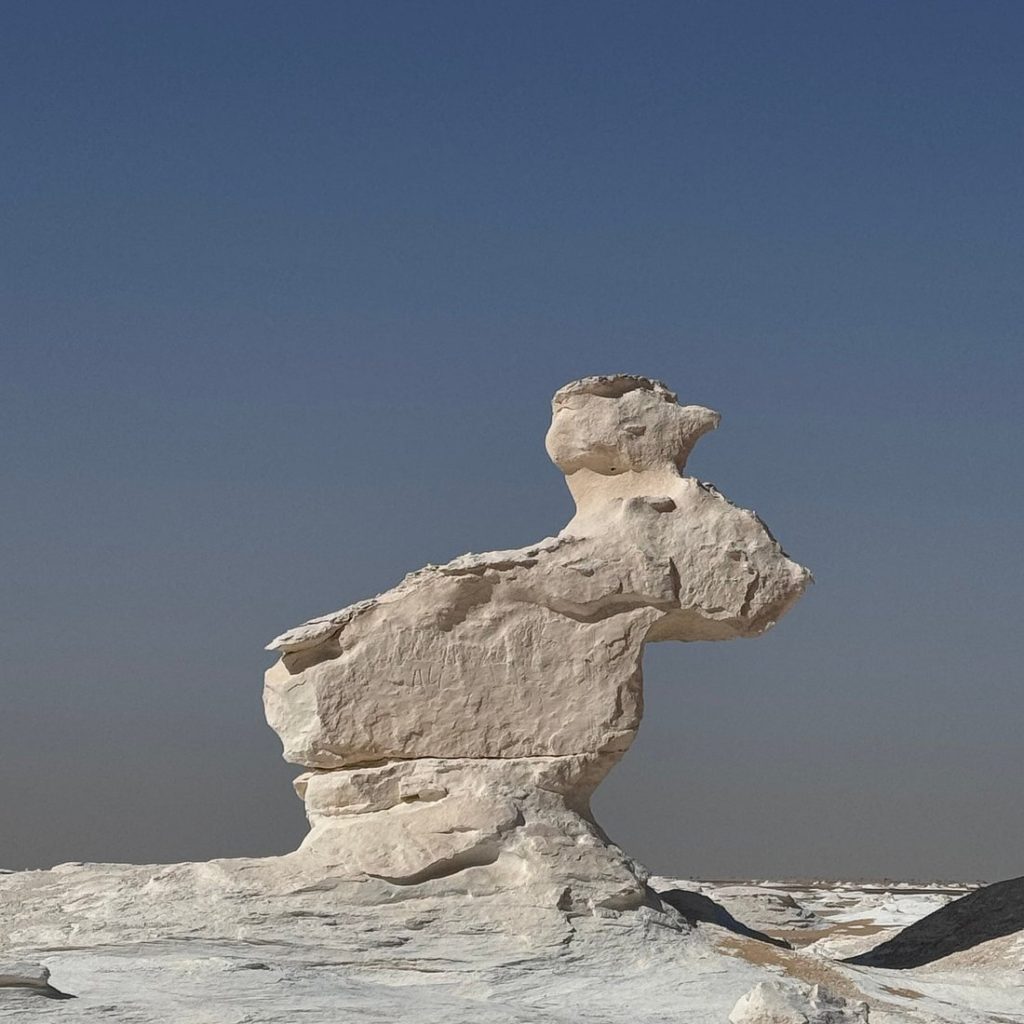
Some resemble giant mushrooms. Others look like birds, animals, pillars, domes, or pieces of modern sculpture. Their shapes change depending on viewing angle, distance, and light, which is why the same formation can appear completely different at sunrise and sunset.
The Egyptian Environmental Affairs Agency describes the area as a natural open-air museum for studying desert environments, geographical phenomena, fossils, and bright limestone formations. The white chalk floor and wind-shaped columns create the visual identity that distinguishes the reserve from nearby dunes and darker desert zones.
Among egypt desert landscapes, few places produce such a strong contrast between pale rock and golden sand.
The Connection with Farafra Oasis
Farafra Oasis provides the human and logistical base for many White Desert trips. It is one of Egypt’s smaller and more isolated oases, surrounded by desert landscapes that include the White Desert, Black Desert, and Great Sand Sea.
A farafra white desert itinerary often includes time in the oasis before or after camping. Visitors may see palm gardens, agricultural areas, local settlements, springs, and simple guesthouses before leaving paved roads behind.
Official tourism guidance describes Farafra as an ideal starting point for Western Desert excursions because the White Desert, Black Desert, Crystal Mountain, and large dune fields are accessible from the oasis.
How Do You Reach the White Desert?
Most visitors reach the region overland. Depending on the itinerary, travelers may travel from Cairo toward Bahariya Oasis and continue south, or approach Farafra through a broader Western Desert route.
Exact routes, checkpoints, permits, and access arrangements can change. Egypt’s official tourism platform advises travelers to check permits and regulations with an authorized guide or travel agency before desert excursions.
Once outside the main settlements, four-wheel-drive vehicles become important. Experienced desert drivers understand sand conditions, navigation, vehicle recovery, fuel planning, and the practical realities of operating far from services.
Do not treat the reserve like a self-drive attraction where you can simply follow a map application. Remote desert travel requires local knowledge, reliable vehicles, water, communications, and contingency planning.
Should You Take a Day Trip or Camp Overnight?
A day trip can introduce the formations, but an overnight camp gives the White Desert its strongest atmosphere.
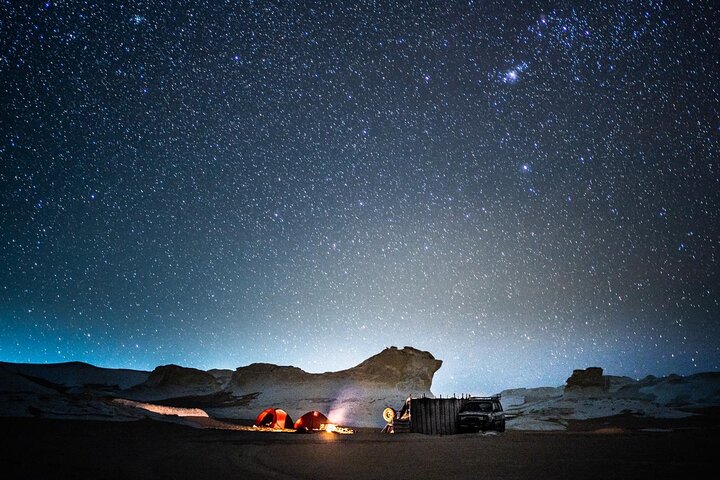
During daylight, the chalk reflects intense sunlight and the landscape can look almost bleached. Near sunset, shadows lengthen and formations become warmer and more dimensional. After dark, the visual focus shifts toward the sky and the silence of the desert.
Camping also removes the pressure to photograph every formation quickly before driving back. You can watch sunset, eat outdoors, sit around a simple camp, sleep in the desert, and experience sunrise before returning toward the oasis.
Official tourism information notes that White Desert excursions can range from one night to much longer trips depending on camping, hiking, camel travel, or four-wheel-drive exploration.
A white desert egypt guide recommends one night for a balanced first-time adventure comfortably.
What Does a Typical Overnight Trip Include?
Packages vary, but a typical expedition begins with a pickup from an oasis or prearranged meeting point. Travelers transfer into a four-wheel-drive vehicle and continue through several desert zones.
Stops may include the Black Desert, Crystal Mountain, Agabat Valley, sand dunes, springs, viewpoints, and selected chalk formations before reaching a camping area.
The crew usually prepares simple meals, tea, bedding, and camping equipment. Facilities can be basic, so travelers should understand exactly what is provided before departure.
Some operators use established camps; others create temporary desert camps with mattresses, blankets, and wind protection. Ask whether toilets, tents, sleeping bags, water, charging, and private arrangements are included.
A higher price does not automatically guarantee better safety or environmental practices. Operator quality matters more than luxury branding.
The Black Desert
The Black Desert provides one of the clearest visual contrasts with the White Desert.
Dark stones cover many hills and create a volcanic-looking landscape, although visitors should avoid assuming every dark feature is volcanic without geological explanation. From viewpoints, black-capped hills rise above lighter desert plains.
Many itineraries stop here while traveling between Bahariya and Farafra. The area works best as part of a sequence because it prepares the eye for how dramatically color and geology change across the Western Desert.
Crystal Mountain
Crystal Mountain is another common stop on desert routes. Despite the name, it is better understood as a geological formation containing prominent crystal structures rather than a conventional mountain covered in loose gemstones.
Official Egyptian tourism information lists Crystal Mountain as one of the geological highlights accessible from Farafra.
The site is visually interesting, but responsible behavior matters. Do not remove stones, crystals, fossils, or geological material. Protected landscapes lose their value quickly when visitors treat natural features as souvenirs.
Agabat Valley
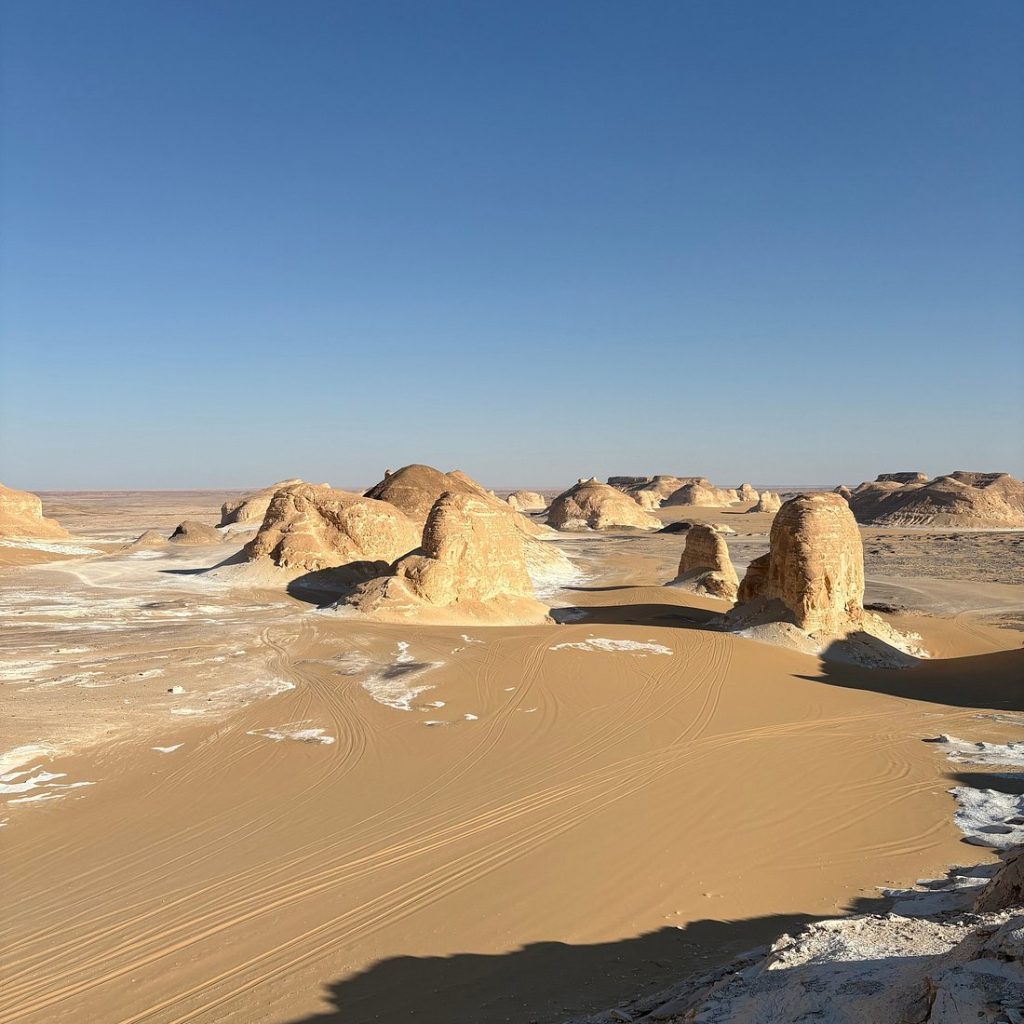
Agabat Valley introduces another style of desert scenery, with sweeping sand, sculpted rock, and broad open views.
The valley often feels larger and less delicate than the close-up chalk formations of the White Desert. Tracks cross sandy terrain while distant rock shapes create layers across the horizon.
Official tourism information highlights Agabat Valley for its soft golden sand and dune scenery.
If your itinerary includes sandboarding or dune driving, ask the operator how activities are managed. Responsible driving should avoid unnecessary damage to fragile surfaces and should never prioritize dramatic maneuvers over passenger safety.
The Famous Chalk Formations
The White Desert’s best-known forms have acquired informal names because they resemble familiar objects. Mushroom-shaped rocks are especially common in photographs, while individual formations may be compared with chickens, rabbits, camels, or abstract figures.
The most rewarding way to experience them is not to race between named photo stops. Walk slowly, where permitted, and notice how erosion has created narrow bases, broad caps, sharp edges, and improbable balances.
Some formations are fragile. Climbing, leaning, carving names, or breaking pieces can cause permanent damage.
A good guide should explain where walking is appropriate and where visitors need to keep their distance.
Sunrise and Sunset
Light transforms the White Desert more dramatically than almost any other factor.
Midday sun reduces shadows and emphasizes the brilliant white surfaces. Late afternoon creates long shadows that reveal texture and depth. Sunset can turn surrounding sand pink, orange, or gold while chalk formations remain pale.
Sunrise is quieter and usually cooler. Travelers who camp overnight can photograph the landscape before packing up and moving toward the next stop.
For photographers, a tripod can be useful for low light, but keep equipment simple enough to protect from sand and dust.
Stargazing in the White Desert
One reason to camp is the night sky.
Far from major cities, artificial light is limited and stars can appear much brighter than they do in Cairo or resort areas. Conditions depend on clouds, moonlight, dust, and season, so no operator can guarantee a perfect sky.
A bright moon can reduce visible stars but illuminate the white formations beautifully. A darker moon phase improves deep-sky visibility.
Bring a headlamp with a low setting and avoid shining strong lights continuously around camp. Your eyes need time to adjust to darkness, and other guests may be trying to enjoy the same sky.
Night temperatures can fall significantly, making warm layers essential.
Wildlife and Desert Etiquette
The desert may look empty, but protected landscapes support wildlife adapted to harsh conditions. The Environmental Affairs Agency identifies the White Desert as an area of geological and natural importance, not simply a recreational playground.
Do not feed wildlife or leave food scraps around camp. Store rubbish carefully and take everything out with you.
Noise also matters. Loud music changes the atmosphere for other visitors and can disturb animals.
Avoid collecting fossils, stones, chalk, plants, or any other natural material. The simplest rule is to leave the landscape looking as though you were never there.
That principle should guide every egypt white desert visit.
When Is the Best Time to Go?
Cooler months are generally the most comfortable for Western Desert travel. Daytime conditions are easier for walking and camping, while nights can become cold.
Spring and autumn can also work, but heat, wind, and dust vary. Summer temperatures can make remote desert travel physically demanding.
What to Pack
Bring lightweight daytime clothing, warm layers for evening, a hat, sunglasses, sunscreen, and closed shoes suitable for sand and uneven ground.
A scarf can help with wind and dust. Pack a headlamp, personal medications, tissues, hand sanitizer, and a power bank.
Carry enough drinking water according to your operator’s instructions and ask how emergency water is stored.
For overnight camping, confirm whether blankets or sleeping bags are included. Travelers who sleep cold may want additional insulation.
Protect cameras and phones from fine dust by keeping them sealed when not in use.
Safety and Choosing an Operator
Remote desert travel should be organized around safety first.
Use an experienced, authorized operator familiar with current access rules. Ask about vehicle condition, backup arrangements, communications, driver experience, water, first aid, and what happens if a vehicle becomes stuck or develops a mechanical problem.
Share your itinerary with someone outside the trip when practical.
Follow instructions at checkpoints and never pressure a driver to enter restricted areas.
The best white desert egypt guide experience is one where safety procedures feel routine rather than dramatic.
How Long Should You Spend?
Two days and one night is enough for an introduction. Travelers with more time can add Farafra, Bahariya, longer hiking, multiple camps, or additional Western Desert landscapes.
Do not underestimate road time. The journey from Cairo and between oases can consume substantial portions of a day.
A rushed schedule turns the desert into a sequence of vehicle stops. A slower itinerary gives you time to walk, photograph, watch light change, and understand the landscape.
Is the White Desert Worth the Detour?
For travelers with only a week in Egypt, Cairo, Luxor, and Aswan may deserve priority.
For travelers with ten days or more, or for repeat visitors, the White Desert can add a completely different dimension.
If you love natural scenery, camping, photography, or unusual environments, the detour can become a highlight.
Among egypt desert landscapes, the White Desert stands out because the scenery changes constantly while still feeling visually coherent.
A Responsible White Desert Experience
The White Desert is protected because its geology and landscape are unusual and vulnerable. Egypt’s Environmental Affairs Agency lists it as a protected landscape covering thousands of square kilometers and highlights its chalk formations, fossils, desert environments, and karst features.
That protection should shape visitor behavior.
Choose operators who remove rubbish, respect designated routes, avoid damaging formations, and follow current regulations. Decline experiences that involve carving rocks, collecting geological material, reckless driving, or leaving waste behind.
Why the White Desert Feels Unforgettable
The farafra white desert experience succeeds because it strips travel down to basic elements: rock, sand, light, temperature, distance, food, silence, and sky.
There are few signs, no museum galleries, and no elaborate visitor choreography. Your understanding comes from moving through the terrain and noticing changes.
The best moments may be unexpected: tea at sunset, morning shadows around a chalk tower, a quiet drive across empty sand, or the first sight of white formations appearing beyond the vehicle.
This white desert egypt guide is ultimately an argument for slowing down. The landscape is impressive in photographs, but its real scale and silence only become clear when you stand inside it.
Frequently Asked Questions
Where is the White Desert in Egypt?
The White Desert lies in Egypt’s Western Desert near Farafra Oasis in the New Valley Governorate. Farafra is the nearest major oasis and an important starting point for excursions into the protected landscape.
Can you visit the White Desert from Cairo?
Yes, but the journey is long and normally forms part of a multi-day overland itinerary rather than a casual sightseeing day. Travelers should use experienced operators and confirm current routes, permits, checkpoints, and access requirements.
Do you need a guide for the White Desert?
Using an authorized, experienced desert operator is strongly recommended. Remote routes require navigation skills, reliable four-wheel-drive vehicles, water, communications, knowledge of regulations, and contingency planning that ordinary independent sightseeing does not provide.
Is camping in the White Desert allowed?
Camping is part of many organized excursions, but regulations and designated areas can change. Confirm current camping rules with your licensed operator and make sure the trip follows protected-area requirements and leaves no waste. Egypt’s official environmental agency currently lists separate White Desert entrance and camping fees.
What is the best time to visit?
Cooler months are generally most comfortable for desert travel because daytime temperatures are easier for walking and nights are suitable for camping with warm layers. Ask about conditions for your exact dates.
What else can you see near the White Desert?
Common regional stops include Farafra Oasis, the Black Desert, Crystal Mountain, Agabat Valley, springs, and dune areas. Routes vary according to starting point, access rules, trip duration, and operator.
Is the White Desert worth visiting on a first Egypt trip?
Yes if natural landscapes and desert adventure are major priorities and you have enough time. Travelers with shorter itineraries may prefer to see Cairo, Luxor, and Aswan first, then add the White Desert on a longer or repeat journey.

0 Comment