
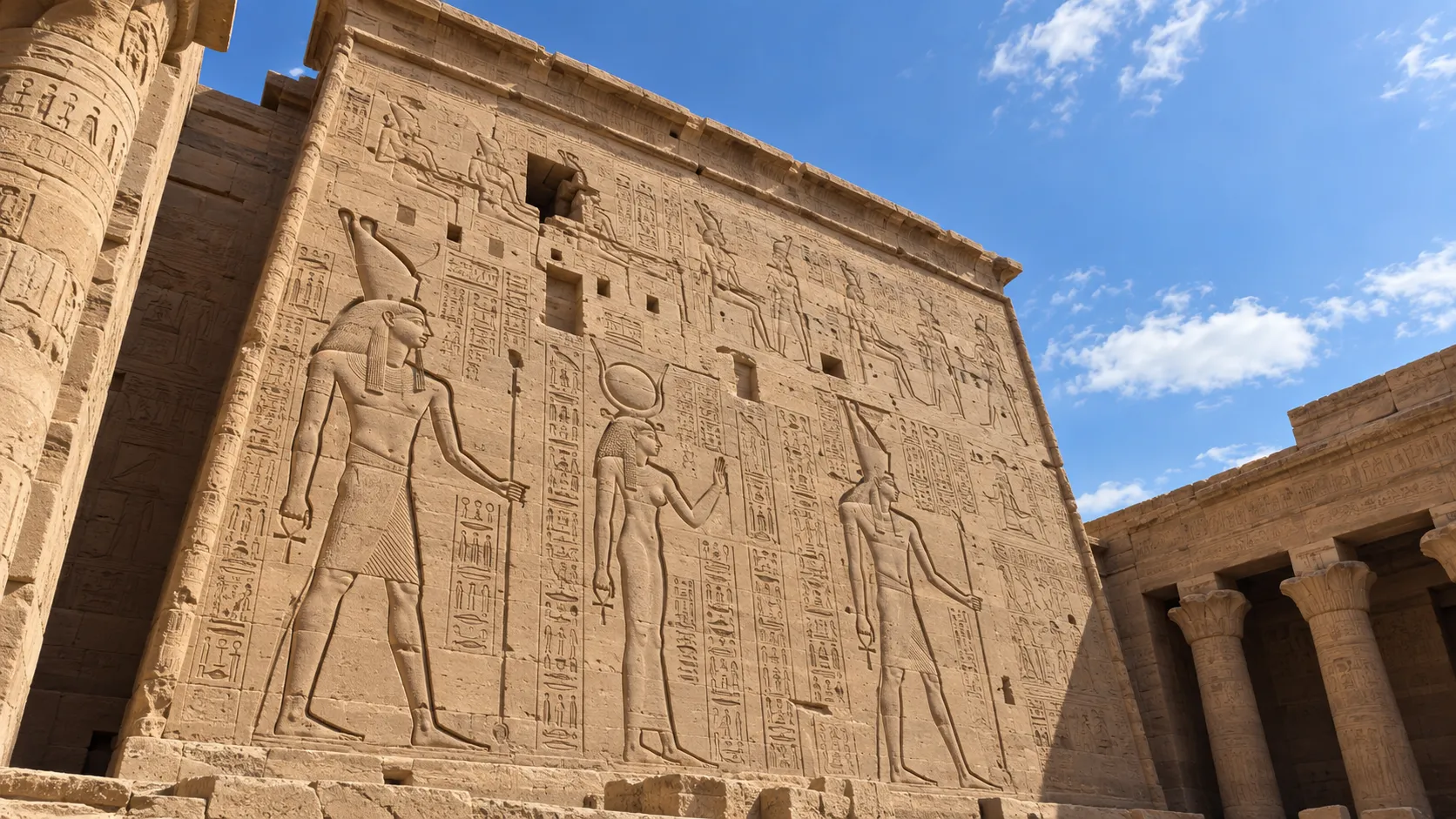

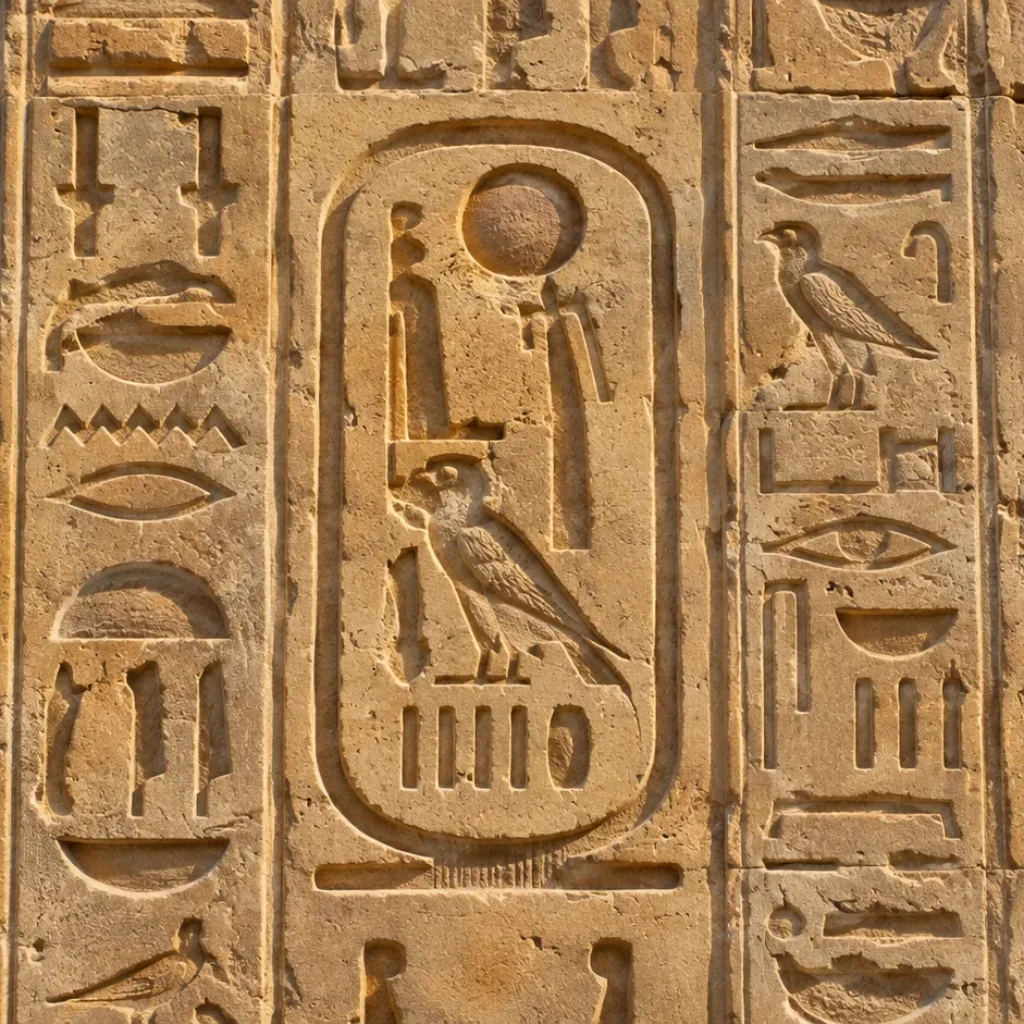
At first glance, Egyptian hieroglyphs can look like a wall of birds, eyes, seated figures, baskets, snakes, and mysterious objects. It is tempting to assume that every picture means exactly what it shows. In reality, hieroglyphic writing is a flexible system in which signs can represent sounds, whole words, or clues about meaning. Once you understand those three jobs, an inscription stops looking like decoration and starts behaving like language.
This beginner’s guide explains how to read Egyptian hieroglyphs at a practical level. You will learn how to find the reading direction, recognize the main types of signs, create a phonetic version of your name, and spot familiar symbols on temple and tomb walls. You will not become an Egyptologist in one sitting, but you will gain a reliable framework for looking at ancient Egyptian writing with informed eyes.
What Are Hieroglyphs? (They’re Not What Most People Think)
The word “hieroglyph” refers to an individual sign, while “hieroglyphic” describes the script. Ancient Egyptian hieroglyphic writing developed shortly before 3100 BCE and remained in use for thousands of years. It appeared on temple walls, tombs, monuments, papyri, coffins, statues, jewelry, and many objects connected with ritual and daily life.
Hieroglyphs are not simply picture writing, and they are not a secret code. They record the ancient Egyptian language. A picture of an owl, for example, may represent the sound m rather than the word “owl.” A sign may also stand for a complete word, or it may sit silently at the end of a word to identify its category. Context determines the sign’s role.
Formal hieroglyphs were especially suited to monuments because writing and art could be designed together. For quicker writing on papyrus, Egyptian scribes also used cursive scripts such as hieratic and, much later, Demotic. This difference helps explain why the carefully carved signs seen in temples may look far more pictorial than everyday administrative writing.
How the Hieroglyph System Works
A useful starting point is to divide signs into three broad functions: phonograms, logograms or ideograms, and determinatives. A single inscription can combine all three.
Phonograms represent sounds. Some carry one consonant, while others carry two or three consonants.
Logograms or ideograms represent a whole word or idea, often related to the object pictured.
Determinatives are silent signs placed near the end of a word to indicate its general meaning, such as a person, place, movement, or abstract idea.
Ancient Egyptian writing usually records consonants and leaves most vowels unwritten. That is why the original pronunciation of many words and names cannot be reconstructed with certainty. Egyptologists insert conventional vowel sounds when speaking, which also explains spelling variations such as Amun/Amen or Ramesses/Rameses.
Phonetic Signs vs. Ideograms
The 24 commonly taught uniliteral signs each represent one consonantal sound. They are often called a “hieroglyphic alphabet,” but that phrase can be misleading: Egyptian scribes did not normally spell every word with single-sound signs alone. They frequently used more efficient biliteral and triliteral signs, then added one-sound phonetic complements to confirm part of the spelling.
The same picture can perform different jobs. A sign depicting an object may write the word for that object when followed by a vertical stroke, yet represent its consonantal value in another word. A determinative, meanwhile, is not spoken at all. It helps the reader distinguish words that share the same consonants, much as context helps English readers distinguish “pair” from “pear.”
Why Hieroglyphs Can Be Read Left to Right or Right to Left
Hieroglyphic lines can run from right to left or left to right, and texts may also be arranged vertically. To find the beginning, look at signs with faces: people, birds, and animals generally face toward the start of the line. If they face left, begin on the left and read toward them; if they face right, begin on the right. In vertical columns, read from top to bottom, while still using the direction of the facing signs to decide which column comes first.
Scribes grouped signs into balanced visual blocks rather than placing them in a rigid alphabetic row. A small sign may be tucked beneath a tall one to fill an imaginary square. Read the block in the overall direction of the text, generally taking upper signs before lower signs. Beauty and legibility worked together.
The Rosetta Stone: How Hieroglyphs Were Deciphered
Knowledge of the script faded after the ancient temples closed. The decisive clue arrived through the Rosetta Stone, discovered in 1799 near Rashid (Rosetta). Its decree appears in hieroglyphic and Demotic Egyptian scripts and in ancient Greek. Because scholars could read Greek, the parallel versions offered a route into the Egyptian texts.
Earlier scholars made important progress, but Jean-François Champollion’s breakthrough in 1822 demonstrated that hieroglyphs could convey phonetic sounds as well as ideas. Royal names enclosed in oval frames were especially useful. By comparing names such as Ptolemy and Cleopatra across known contexts, researchers could test the sound values of signs. The crucial lesson was that the system was neither purely symbolic nor purely alphabetic; it combined several principles.
Write Your Name in a Hieroglyph Cartouche
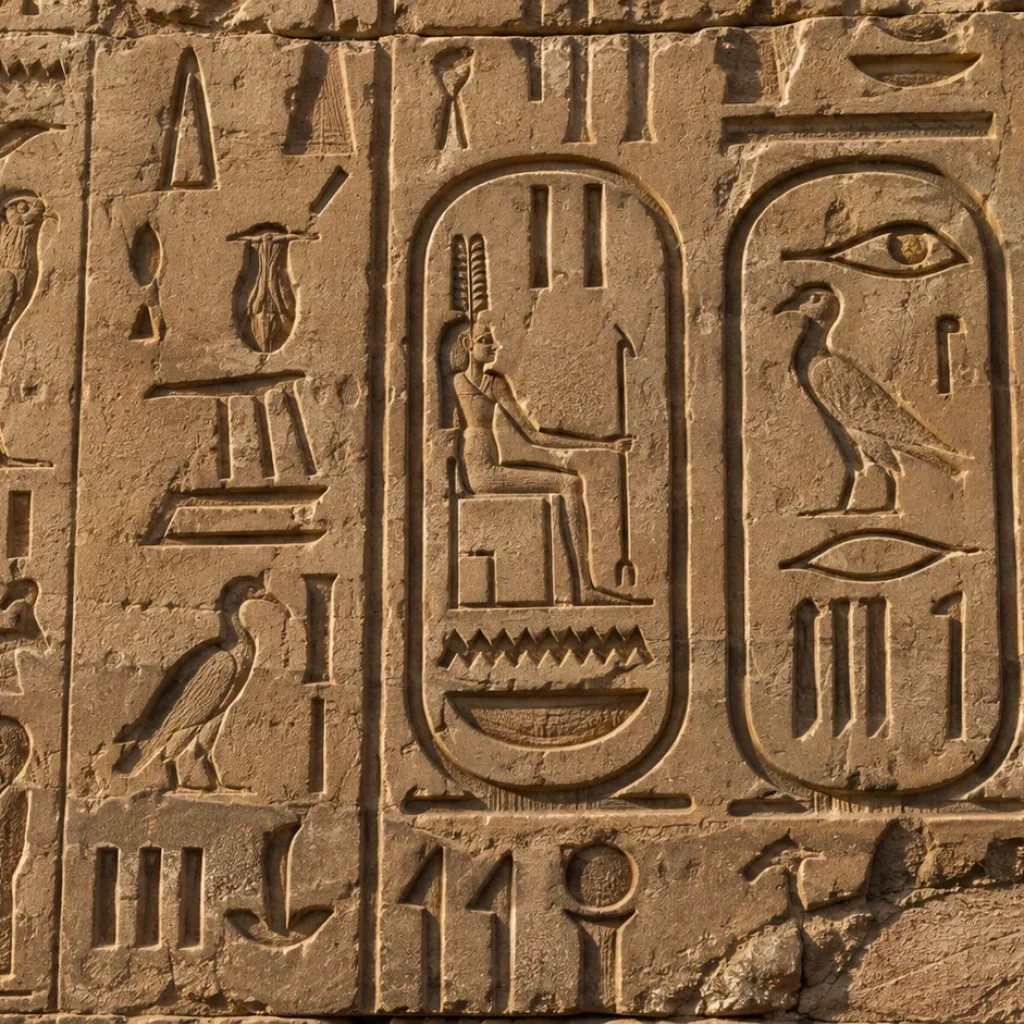
A cartouche is the modern name for an elongated oval enclosure derived from the shen ring. In ancient inscriptions it was primarily used around royal names, not around every person’s name. Writing your own name inside one is therefore a modern educational and decorative activity, but it is an excellent way to practice sound-based signs.
The goal is transliteration, not translation. You are approximating the sounds of a modern name with ancient Egyptian consonantal signs. Spell the name as it sounds, ignore most silent letters, and remember that there may be more than one reasonable result.
Step-by-Step Guide With the Full Sound Key
Say your name slowly and divide it into sounds, not English letters. “Philip,” for example, begins with an f sound even though it is written with ph.
Remove or minimize vowels. In a playful modern rendering, you may use reed-leaf, vulture, quail-chick, or double-reed signs to suggest vowel-like sounds, but ancient Egyptian spelling did not match modern English vowels exactly.
Choose the closest consonantal signs from the table below. Use k for a hard c, s for a soft c, and k+s for x. English l is often approximated with the lion sign used in later name writing, while v can be approximated with f.
Arrange the signs into visually balanced groups. Preserve the correct order even if one sign sits above another.
Draw an oval around the group and add the short closing line at one end. That creates the familiar modern cartouche presentation.
Read it back by sound. If the result no longer resembles your spoken name, revise the phonetic breakdown rather than copying the English spelling mechanically.
Beginner Sound Key for Modern Names
Modern sound — Sign to draw — Practical note
A or glottal onset — Vulture or reed leaf: Approximation used for modern names; not an exact English A.
B — Foot: A single-consonant b sign.
C — Use K or S: Choose by sound: cat becomes k, while city becomes s.
D — Hand: A single-consonant d sign.
E — Reed leaf: Modern approximation; vowels were normally omitted.
F or V — Horned viper: Use f as the closest common approximation for v.
G — Jar stand: Hard g approximation.
H — Reed shelter or twisted flax: Several Egyptian h-like consonants existed.
I or Y — Reed leaf or double reed: Useful for y and vowel-like modern spellings.
J — Cobra or d+j approximation: Modern name charts vary, so choose by pronunciation.
K, hard C, or Q — Basket: A common k sound approximation.
L — Lion: Common in later or foreign-name conventions; not one of the classic 24 uniliterals.
M — Owl: A single-consonant m sign.
N — Water ripple: A single-consonant n sign.
O — Quail chick: Modern approximation, often treated through w or u.
P — Reed mat or stool: A single-consonant p sign.
R — Mouth: A single-consonant r sign.
S or soft C — Folded cloth or door bolt: Egyptian had more than one s-like consonant.
SH — Pool: Represents the sh sound.
T — Bread loaf: A single-consonant t sign.
TH — Use T, D, or T+H: Choose according to the spoken sound.
U or W — Quail chick: Represents w and is often used for modern u or o approximations.
X — K + S: Write the two spoken consonants.
Z — Door bolt or S approximation: Often approximated with an s-like sign in modern names.
For example, “Maya” can be treated as the consonant sequence M-Y. Draw the owl for m and a reed sign for y, then place them inside the oval. A modern chart may add an initial or final vowel-like sign, but M-Y is closer to the consonant-based logic of the ancient system. For an instant visual version, the Penn Museum’s online name tool offers a useful starting point; treat its output as an educational rendering rather than a certified ancient spelling.
The Most Common Hieroglyphs You’ll See in Egyptian Temples
Even before you can translate a sentence, a few recurring signs can make temple walls feel more familiar:
Ankh: The looped cross meaning “life,” often shown being offered to the king by a deity.
Djed pillar: Associated with stability and endurance and closely linked with Osiris.
Was sceptre: A sign of power or dominion, frequently held by gods.
Eye of Horus or wedjat: Associated with wholeness, restoration, and protection.
Scarabs: The beetle sign can carry the sound kheper and ideas of becoming or coming into existence.
Sun disk: Can represent the sun and the god Re and appears in many royal names and titles.
Sedge and bee: Royal signs used in the title conventionally translated as “King of Upper and Lower Egypt.”
Cartouches: Oval enclosures identifying royal throne names and birth names.
Do not assume that every familiar sign has one fixed translation. Its sound, grammatical role, and neighboring signs all matter. Start by recognizing patterns, then confirm them with a reliable sign list or inscription guide.
Hieroglyphs to Look For at Each Major Monument
The fastest way to make this knowledge memorable is to use it on location. If you are planning an Egypt trip, explore the available Luxor tours and consider how inscriptions change between temples, royal statues, and tombs.
Karnak Temple
At Karnak Temple, look for the name of Amun-Re, royal cartouches, and scenes in which a king presents offerings to a deity. The temple complex was expanded by many rulers, so its inscriptions are also a record of royal building, restoration, and self-presentation across centuries. On tall columns and pylons, pause first to identify the reading direction, then find repeated royal names and titles before attempting a full line.
Abu Simbel
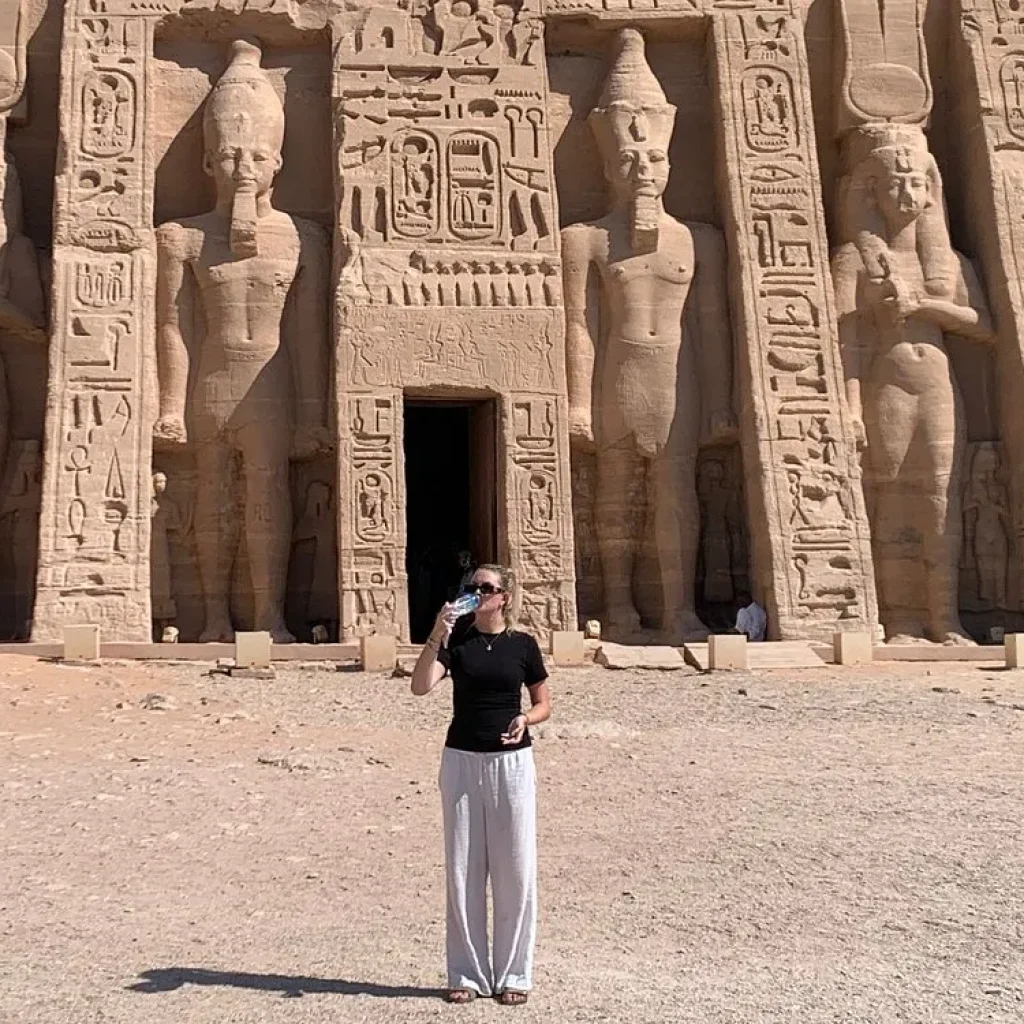
At the Abu Simbel temples, Ramesses II’s cartouches appear repeatedly, reinforcing the identity and authority of the king. In the Great Temple, inscriptions accompany battle imagery, ritual scenes, and figures of deities. Repetition is your friend: once you locate one cartouche, compare its sign pattern with others nearby. In the smaller temple dedicated to Hathor and Queen Nefertari, look for the queen’s name and titles alongside divine imagery.
Valley of the Kings
In the Valley of the Kings, hieroglyphs are woven into funerary compositions designed to guide and protect the deceased ruler through the afterlife. Watch for the ankh, djed, solar signs, divine figures, and repeated royal cartouches. Texts may run in long columns and interact closely with painted scenes, so use the direction of human and animal signs to establish where each passage begins. The content is more than biography: it includes ritual speech, divine encounters, and maps of the king’s cosmic journey.
The same skills also enrich a visit to the Great Pyramid of King Khufu. The pyramid’s interior does not display the extensive carved funerary texts found in some later royal monuments, which is itself an important reminder that Egyptian burial traditions developed over time. Learning about the changing roles and titles of the pharaohs of Egypt provides essential context for the royal names you will encounter.
Before attempting to translate a complete inscription, spend time observing its structure. Identify the reading direction, locate any cartouches, and search for repeated groups of signs. Repetition often indicates a royal name, title, divine name, or formula used throughout the scene. Next, separate signs that may represent sounds from larger figures that could act as determinatives. Photographing an inscription, where permitted, can help you study these details later without rushing. Compare your observations with a reliable sign list and remember that damaged surfaces may hide essential signs. This patient method will help you build confidence gradually while avoiding quick conclusions based only on the appearance of individual pictures or an incomplete modern alphabet chart.
Apps and Resources for Learning More
For casual practice, use a reputable museum name generator, a sign chart, and clear photographs of inscriptions. For structured study, choose a course that introduces transliteration, uniliteral/biliteral/triliteral signs, phonetic complements, determinatives, basic grammar, and the standard sign list. Useful starting points include:
Bibliotheca Alexandrina’s Learn Hieroglyphs lessons, which progress from sign types and writing direction into grammar and quizzes.
UCL’s Digital Egypt pages, especially its introductions to the writing system and orientation.
The Penn Museum’s Write Your Name in Hieroglyphs activity for a quick, playful cartouche rendering.
The Metropolitan Museum of Art’s ancient Egypt educator resources for the relationship between hieroglyphs, sound signs, ideograms, and art.
When using phone apps, check who created the content. A tool that maps every English letter to one picture without explaining pronunciation, missing vowels, or alternative consonants may be fun, but it is not a complete guide to ancient Egyptian writing.
Start Reading the Walls, One Pattern at a Time
Learning how to read Egyptian hieroglyphs begins with a change in perspective: the pictures are not merely pictures. They can carry sounds, words, and silent meaning clues. Start by finding the reading direction, separate phonetic signs from determinatives, and train your eye to notice repeated royal names and symbols.
Writing your name in a cartouche is a memorable first exercise, provided you treat it as a modern phonetic approximation. Then take that curiosity to the monuments. The first time you recognize an ankh, identify a cartouche, or follow a line toward the faces of its birds and figures, the wall becomes more than an image—it becomes a text.
Ready to see these inscriptions in their original setting? Explore Egypt tour packages and experience the temples, tombs, and royal names in person.







0 Comment